

Build a School Management System with Class Inheritance
Level: Beginner

Yesterday we built a grade calculator using classes (see the project here: https://dailypythonprojects.substack.com/p/build-a-grade-calculator-with-classes). Today, we’re extending it by learning inheritance — one of the most powerful concepts in Object-Oriented Programming! We’ll create a Person base class and have both Student and Teacher classes inherit from it, showing how code reusability works in real applications.
Project Task
Create a school management system with inheritance that:
Uses a base
Personclass with name and age attributesCreates a
Studentclass that inherits fromPersonand adds scoresCreates a
Teacherclass that inherits fromPersonand adds subjectUses the
super()function to call the parent class constructorDemonstrates how child classes inherit parent methods
Shows how child classes can add their own unique methods
Creates instances of both Student and Teacher objects
Displays information for both types of people in the system
This project gives you hands-on practice with inheritance, the super() function, parent-child relationships, and code reusability — essential skills for building scalable, maintainable applications.
Expected Output
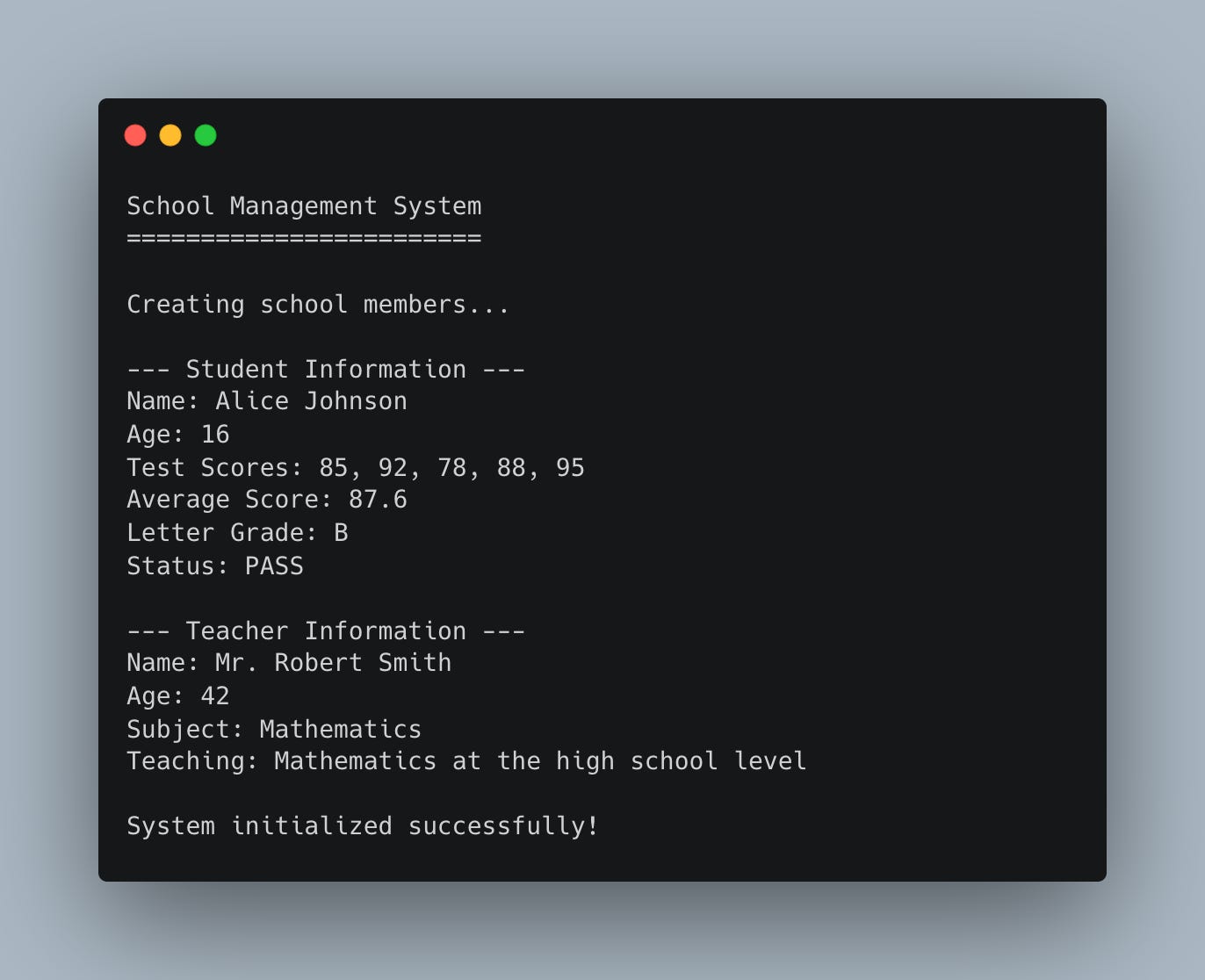
And here is the code of the previous project to help you start with today’s project:
# Print header
print("Grade Calculator (OOP Version)")
print("==============================\n")

# Define the Student class
class Student:

    # Initialize the student with name and scores
    # (use __init__ method with self parameter)
    def __init__(self, name, scores):
        self.name = name
        self.scores = scores

    # Method to calculate average score
    # (access self.scores to calculate average)
    def calculate_average(self):
        average = sum(self.scores) / len(self.scores)
        return average

    # Method to convert average to letter grade
    # (use self.calculate_average() to get the score)
    def get_letter_grade(self):
        score = self.calculate_average()
        if score >= 90:
            return "A"
        elif score >= 80:
            return "B"
        elif score >= 70:
            return "C"
        elif score >= 60:
            return "D"
        else:
            return "F"

    # Method to determine pass/fail status
    # (use self.calculate_average() to get the score)
    def get_status(self):
        score = self.calculate_average()
        if score >= 60:
            return "PASS"
        else:
            return "FAIL"

    # Method to generate the complete report
    # (call other methods using self)
    def generate_report(self):
        average = self.calculate_average()
        letter_grade = self.get_letter_grade()
        status = self.get_status()

        print("\nStudent Grade Report")
        print("====================")
        print(f"Name: {self.name}\n")
        print(f"Test Scores: {', '.join(map(str, self.scores))}")
        print(f"Average Score: {average:.1f}")
        print(f"Letter Grade: {letter_grade}")
        print(f"Status: {status}\n")

# Get user input
# (student name)
name = input("Enter student name: ")

# Get test scores
# (comma-separated string, convert to list of integers)
scores_input = input("\nEnter test scores (comma-separated): ")
scores = [int(score.strip()) for score in scores_input.split(',')]

# Print processing message
print("\nProcessing grades...")

# Create a Student object
# (instantiate the class with name and scores)
student = Student(name, scores)

# Generate the report
# (call the generate_report method on the student object)
student.generate_report()

# Print completion message
print("Report generated successfully!")
Skeleton and Solution
Below you will find both a downloadable skeleton.py file to help you code the project with comment guides and the downloadable solution.py file containing the correct solution.
Get the code skeleton here:
Keep reading with a 7-day free trial
Subscribe to Daily Python Projects to keep reading this post and get 7 days of free access to the full post archives.